
merits discussion. They argue, and we agree, that the trial court erred in declaring that the referendum violated section 124.011. For the reasons that follow, we reverse the order.
Factual Background
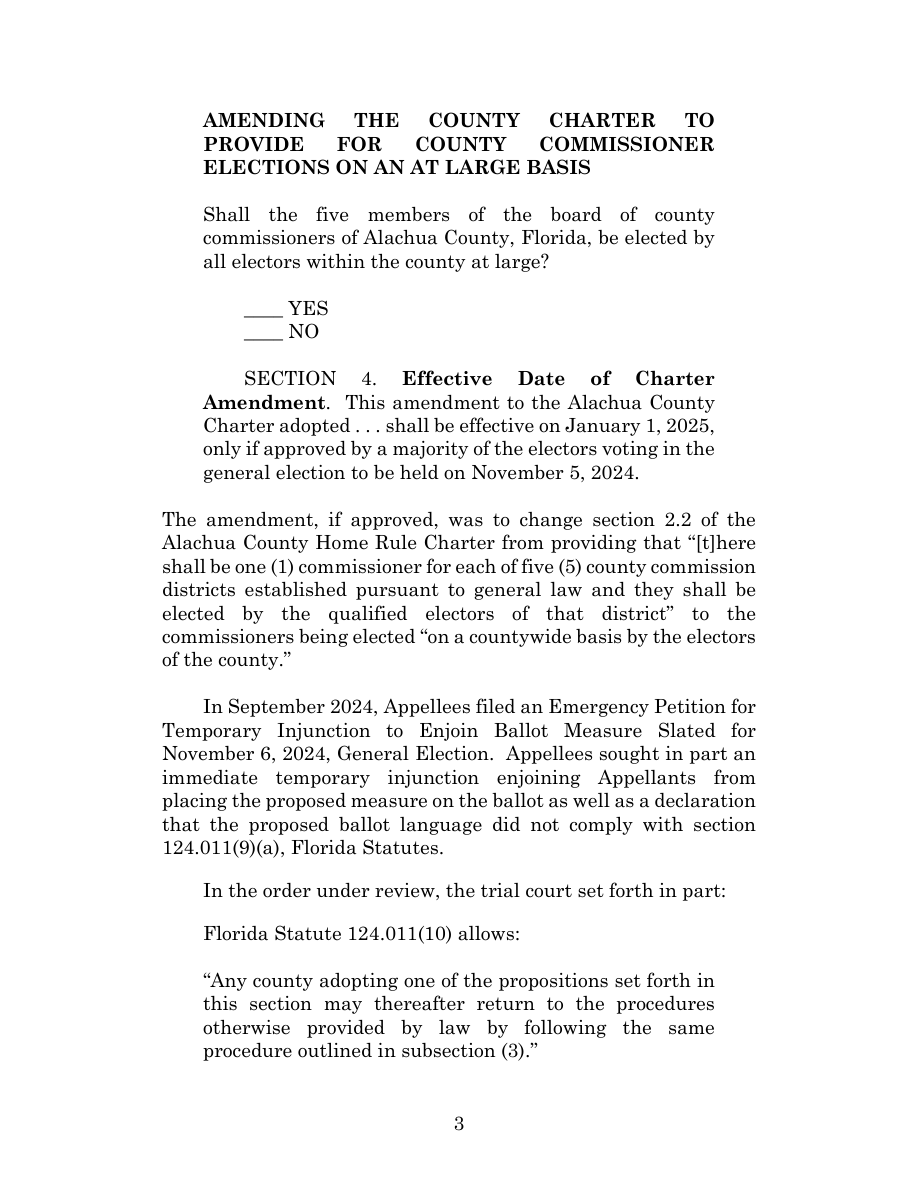
In 2022, Alachua County voters approved a change from an at-large voting system for county commissioners to voting for members using a single-member district system. According to testimony presented below, at-large means that “everybody in the entire county votes for every county commissioner,” whereas in a single-member system, “only the people in your district can vote for you.”* This case involves an ordinance of the Alachua County Board of County Commissioners (Ordinance 2024-12), which included a proposed amendment to the Alachua County Charter pertaining to members of the Board being elected on a countywide basis and which provided in part:
SECTION 3. Referendum.
a. The proposed amendment to the Alachua County Charter in Section 2 of this ordinance shall be presented to the County electorate on the ballot at the general election to be held on November 5, 2024.
b. The Supervisor of Elections of Alachua County shall cause the following question to be placed on the ballot at the general election to be held on November 5, 2024.
* The impetus for the change was House Bill 1493, which called for a referendum election on November 8, 2022, with the following referendum question: “Shall the five members of the board of county commissioners of Alachua County, Florida, be elected to office from single-member districts by electors residing in each of those districts only?” If the question was answered affirmatively by a majority of the qualified electors, which it was, then the charter amendment was to take effect, which it did.
Thus, the commission could again place an issue before the voters regarding voting by single member districts versus at large districts. Whether the commissioners have acted in good faith by placing the issue before the voters again in such a short period of time is a political question, not a legal one upon which the court can act.
However, the commissioners have violated the procedure outlined in Florida Statute 124.011. If the commissioners want the voters to again lawfully consider the issue, they must use the language used in 2022 and specifically found [in] Florida Statute 124.011(9)(a):
[]Shall the five members of the board of county commissioners of Alachua County, Florida, be elected to office from single-member districts by electors residing in each of those districts only?
_____ Yes _____ No
Because the language in the current proposed referendum does not comply with Florida law, any resulting vote will be a legal nullity and not the basis for changing the voting method, if the result is a vote for at large voting. Hypothetically the vote, if the No Vote prevails, would render the question moot.
The trial court denied Appellees’ request for a temporary injunction, but it ruled that the amendment “addressing at large elections that is on the November 5, 2024 ballot is declared to be unlawful in violation of Florida Statute 124.011 in that its ballot language fails to comply with the statute.” Alachua County voters subsequently approved the referendum. This appeal followed.
Analysis
Statutory construction is a question of law. State v. Rogers, 391 So. 3d 661, 666 (Fla. 1st DCA 2024). To ascertain legislative intent, a court must first look to the plain and obvious meaning of the statute’s text. Id. at 666–67. If the language is clear and unambiguous and conveys a clear and definite meaning, a court should apply the unequivocal meaning and not resort to the rules of statutory construction. Id. at 667; see also Ham v. Portfolio Recovery Assocs., LLC, 308 So. 3d 942, 946 (Fla. 2020) (following the “supremacy-of-text” principle, which provides that the words of a governing text are of paramount concern and what the words convey is what the text means). Courts are not at liberty to extend, modify, or limit a statute’s express terms. Univ. of Fla. Bd. of Trs. v. Browning, 387 So. 3d 371, 376–77 (Fla. 1st DCA 2024).
Section 124.01, Florida Statutes (2024), entitled “Division of counties into districts; county commissioners,” provides in part:
(1) There shall be five county commissioners’ districts in each county, which shall be numbered one to five, inclusive, and shall be as nearly equal in proportion to population as possible.
(2) There shall be one county commissioner for each of such county commissioners’ districts, who shall be elected by the qualified electors of the county, as provided by s. 1(e), Art. VIII of the State Constitution.
As the parties acknowledge, section 124.01 makes clear that the default method of voting for county commissioners in Florida is an at-large system.
Section 124.011, Florida Statutes (2024), entitled “Alternative procedure for the election of county commissioners to provide for single-member representation; applicability,” provides in part as follows:
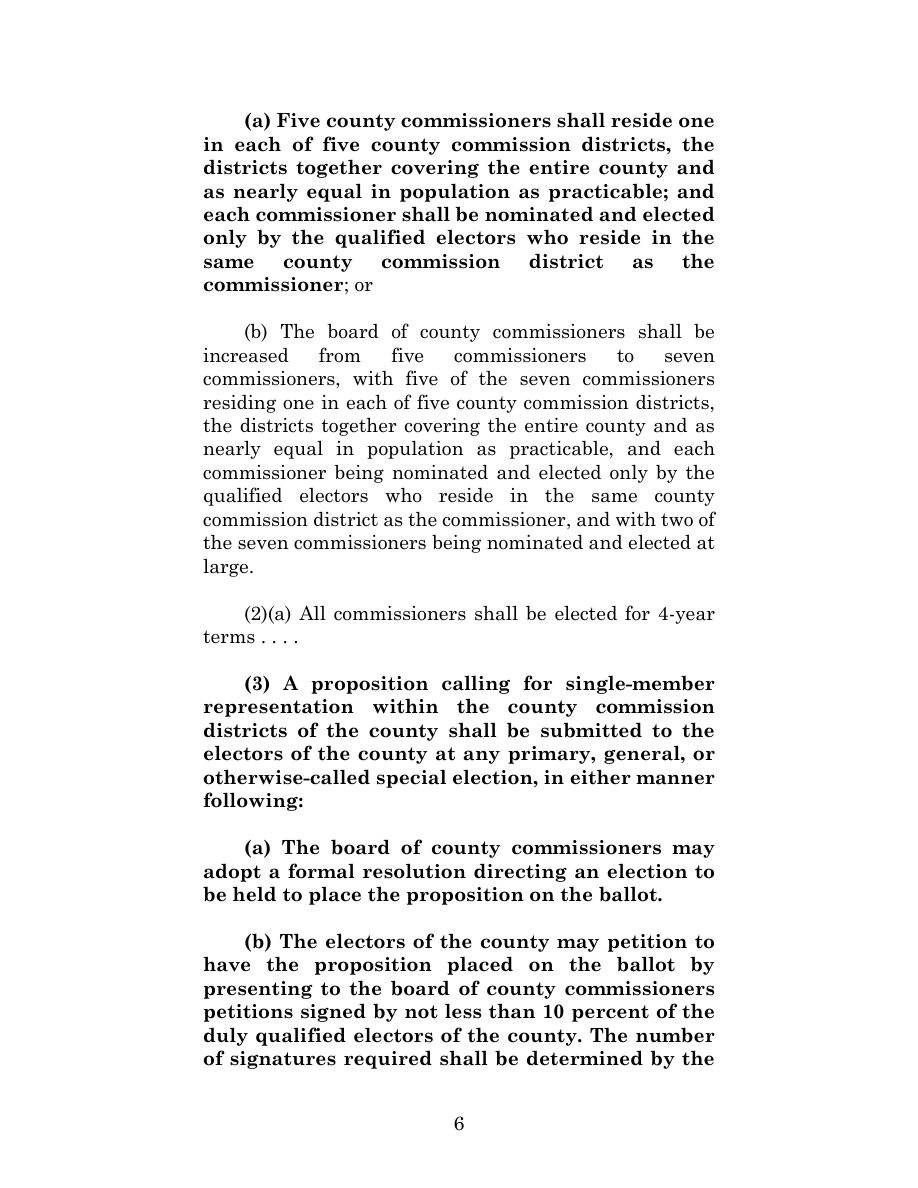
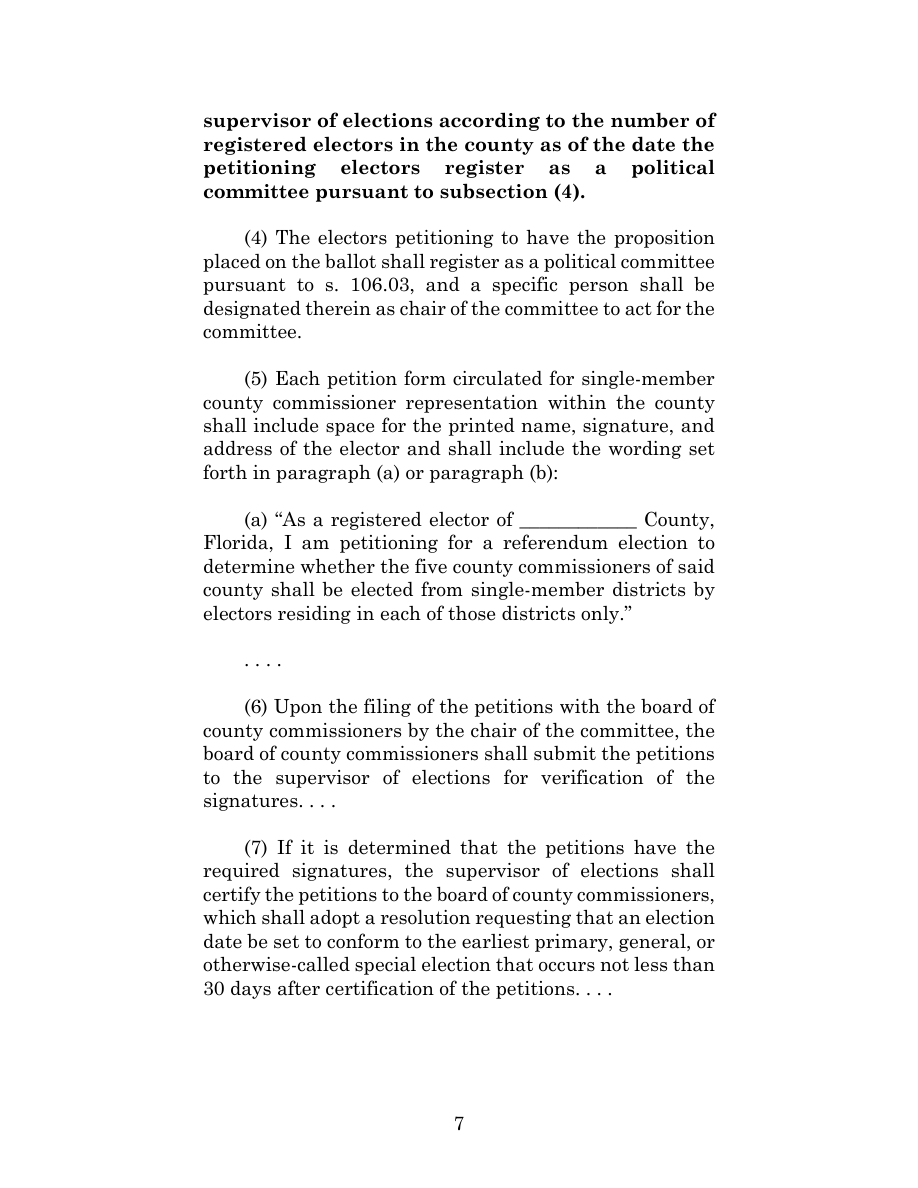
(1) County commissioners shall be nominated and elected to office in accordance with the provisions of s. 124.01, or as otherwise provided by law, unless a proposition calling for single-member representation within the county commission districts is submitted to and approved by a majority of the qualified electors voting on such proposition in the manner provided in this section. Such proposition shall provide that:
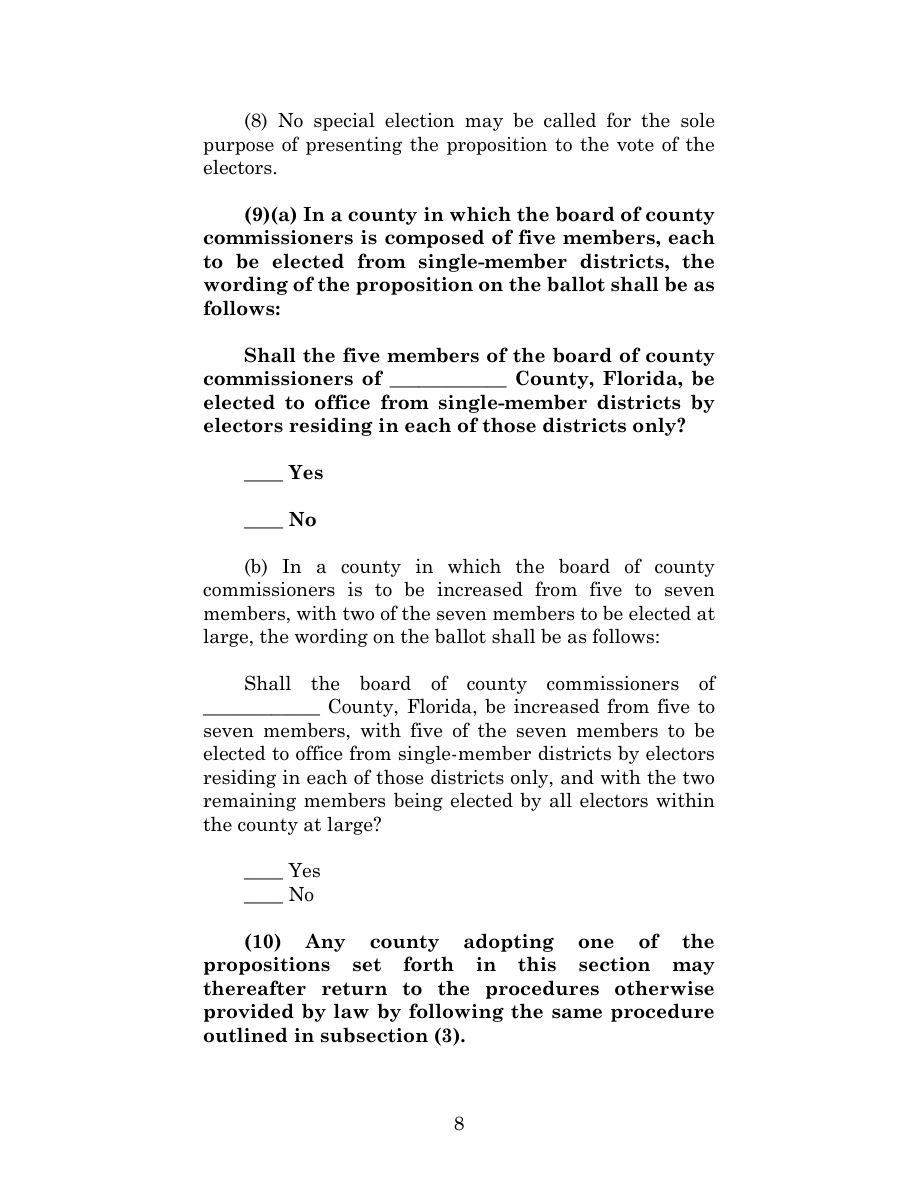
(11) No county commissioner elected prior to or at the election which approves any revision as permitted in this section shall be affected in his or her term of office. The resolution adopted by the board of county commissioners under paragraph (3)(a) or subsection (7) which presents the proposed revision to the electorate for approval shall specify an orderly method and procedure for implementing the revision contemplated in the resolution.
(Emphasis added).
The trial court determined that the County violated the procedure outlined in section 124.011 and that “[i]f the commissioners want the voters to again lawfully consider the issue, they must use the language used in 2022 and specifically found [in] Florida Statute 124.011(9)(a).” This interpretation of the statute was erroneous. Section 124.011 allows for the alternative of single-member districts and includes the procedures and parameters of implementing that alternative system. The referendum at issue in this case addressed the potential return to at-large voting from a single-member system. Given such, section 124.011(10), which is the only provision in the statute that contemplates a reversion back to an at-large system of voting, was applicable here. Because subsection (3) is the only provision that subsection (10) references, the procedure outlined in subsection (3) must be followed in order to return to that system. Subsection (3) says nothing about how the proposal to return to at-large voting must be worded. It certainly does not say that the language contained in subsection (9) must be included. Subsection (9) clearly applies when a referendum is proposing a switch from at-large voting to single-member districts, not the other way around. Had the Legislature wished to include specific language that must be included on the ballot for a return to at-large voting in section 124.011 or elsewhere, it could have done so. Because it did not, the trial court erred in declaring that the 2024 ballot language violated section 124.011(9).
Accordingly, we REVERSE the order on appeal.
LEWIS and RAY, JJ., concur; and TANENBAUM, J., concurs in result only.
Not final until disposition of any timely and authorized motion under Fla. R. App. P. 9.330 or 9.331.
Peter D. Webster of Carlton Fields, Tallahassee; Sylvia E. Torres, County Attorney, Robert C. Swain, Deputy County Attorney, Alachua County Board of County Commissioners, Gainesville; Corbin Hanson, Senior Assistant County Attorney, Alachua County Supervisor of Elections, Gainesville, for Appellants.
Seldon J. Childers of Childers Law, LLC, Gainesville; William D. Palmer and Shannon McLin of Florida Appeals, Orlando; Benjamin J. Gibson, Amber S. Nunnally, and Kassandra S. Reardon of Shutts & Bowen LLP, Tallahassee, for Amicus Curiae Leading For Our Future Political Committee, for Appellees.