
FIRST DISTRICT COURT OF APPEAL STATE OF FLORIDA
No. 1D2023-0941
PUBLIX SUPER MARKETS, INC., NORMANDY INSURANCE COMPANY, ZENITH INSURANCE COMPANY, BRIDGEFIELD EMPLOYERS INSURANCE COMPANY, BRIDGEFIELD CASUALTY INSURANCE COMPANY, BUSINESSFIRST INSURANCE
COMPANY, and RETAILFIRST
INSURANCE COMPANY,
Appellants,
v.
DEPARTMENT OF FINANCIAL SERVICES, DIVISION OF WORKERS’ COMPENSATION, PRESCRIPTION PARTNERS, LLC; FLORIDA MEDICAL ASSOCIATION; FLORIDA OSTEOPATHIC MEDICAL
ASSOCIATION; and FLORIDA
ORTHOPAEDIC SOCIETY,
Appellees.
_____________________________
On appeal from the Division of Administrative Hearings. Darren A. Schwartz, Administrative Law Judge.
February 25, 2026
NORDBY, J.
Under a longstanding provision of Florida’s Workers’ Compensation Law, an injured employee has a “free, full, and absolute choice” of which “pharmacy or pharmacist” fills and dispenses any required prescriptions under Chapter 440. To resolve this case, we must decide whether a physician authorized to dispense medication under section 465.0276, Florida Statutes, is considered a pharmacist within the meaning of this “absolute choice” provision in section 440.13, Florida Statutes.
The underlying proceeding arose in 2023, when the Department of Financial Services, through its Division of Workers’ Compensation, issued proposed rules interpreting section 440.13’s “absolute choice” language to include healthcare practitioners who are authorized to dispense drugs directly to their patients. The proposed rules prohibit workers’ compensation insurance carriers from denying authorization or reimbursement for prescription medication solely because a “dispensing practitioner” dispenses the medication.
Appellants, a group of companies affected by the proposed rules, filed an administrative petition challenging the proposals as invalid exercises of delegated legislative authority. Ultimately, after a hearing, the Division of Administrative Hearings (DOAH) issued a final order rejecting Appellants’ claims and dismissing the petition. Because we find that the proposed rules improperly enlarge, modify, or contravene the “absolute choice” provision in section 440.13(3)(j), Florida Statutes (2022), we set aside that final order.
I.
We begin with some basic background. Florida’s workers’ compensation system is set out in Chapter 440 of the Florida Statutes. The Legislature based this statutory no-fault system “on a mutual renunciation of common-law rights and defenses by employers and employees alike” and designed the regime to be “self-executing.” § 440.015, Fla. Stat. The law generally immunizes employers from suits by employees for injuries arising out of and in the course of employment; in exchange, the employer must pay the employee indemnity benefits related to lost work and provide the employee medically necessary remedial treatment, care, and attendance for the injury. § 440.13(2)(a), Fla. Stat. This includes any medically necessary prescription medication.
To receive payment under Chapter 440, a medical provider who renders non-emergency services must receive authorization from the employer’s workers’ compensation insurance carrier before providing treatment. § 440.13(13)(a), Fla. Stat. With limited exceptions, the carrier selects and authorizes the provider who will provide treatment to the injured employee. After the injured employee receives the authorized treatment, the provider bills the carrier directly, and the carrier pays.
One significant exception to the typical carrier authorization structure is prescription medication. Before 1994, carriers had sole control over where injured employees could go to have their prescription medications dispensed. But that changed. In a 1993 special session, the Legislature amended Chapter 440 to allow injured employees the “free, full, and absolute choice” to select any pharmacy or pharmacist to dispense medications. See Laws of Fla. 93-415 at 103 (codified as § 440.13(3)(j), Fla. Stat. (1994)). Since then, the Legislature has made no substantive changes to this “absolute choice” provision:
Notwithstanding anything in this chapter to the contrary, a sick or injured employee shall be entitled, at all times, to free, full, and absolute choice in the selection of the pharmacy or pharmacist dispensing and filling prescriptions for medicines required under this chapter. It is expressly forbidden for the department, an employer, or a carrier, or any agent or representative of the department, an employer, or a carrier, to select the pharmacy or pharmacist which the sick or injured employee must use; condition coverage or payment on the basis of the pharmacy or pharmacist utilized; or to otherwise interfere in the selection by the sick or injured employee of a pharmacy or pharmacist.
§ 440.13(3)(j), Fla. Stat.
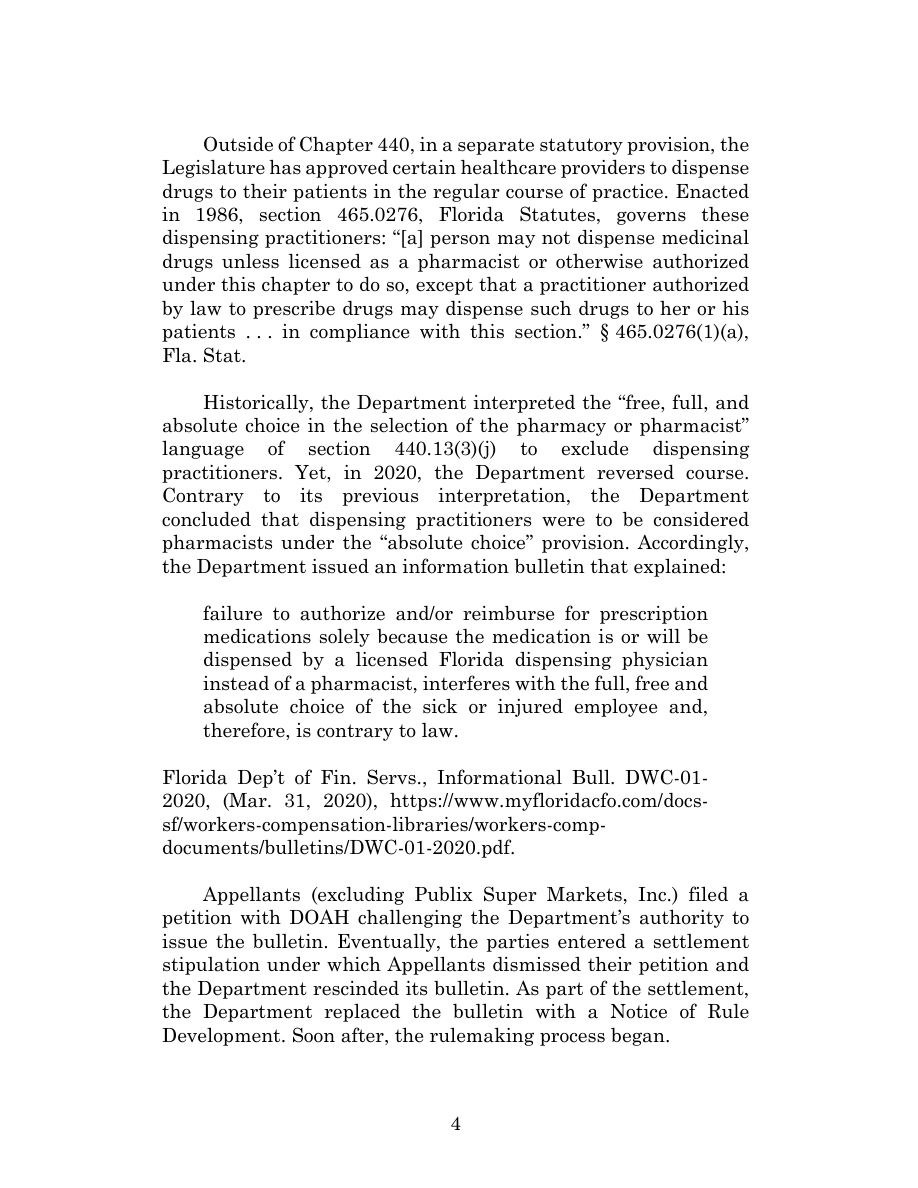
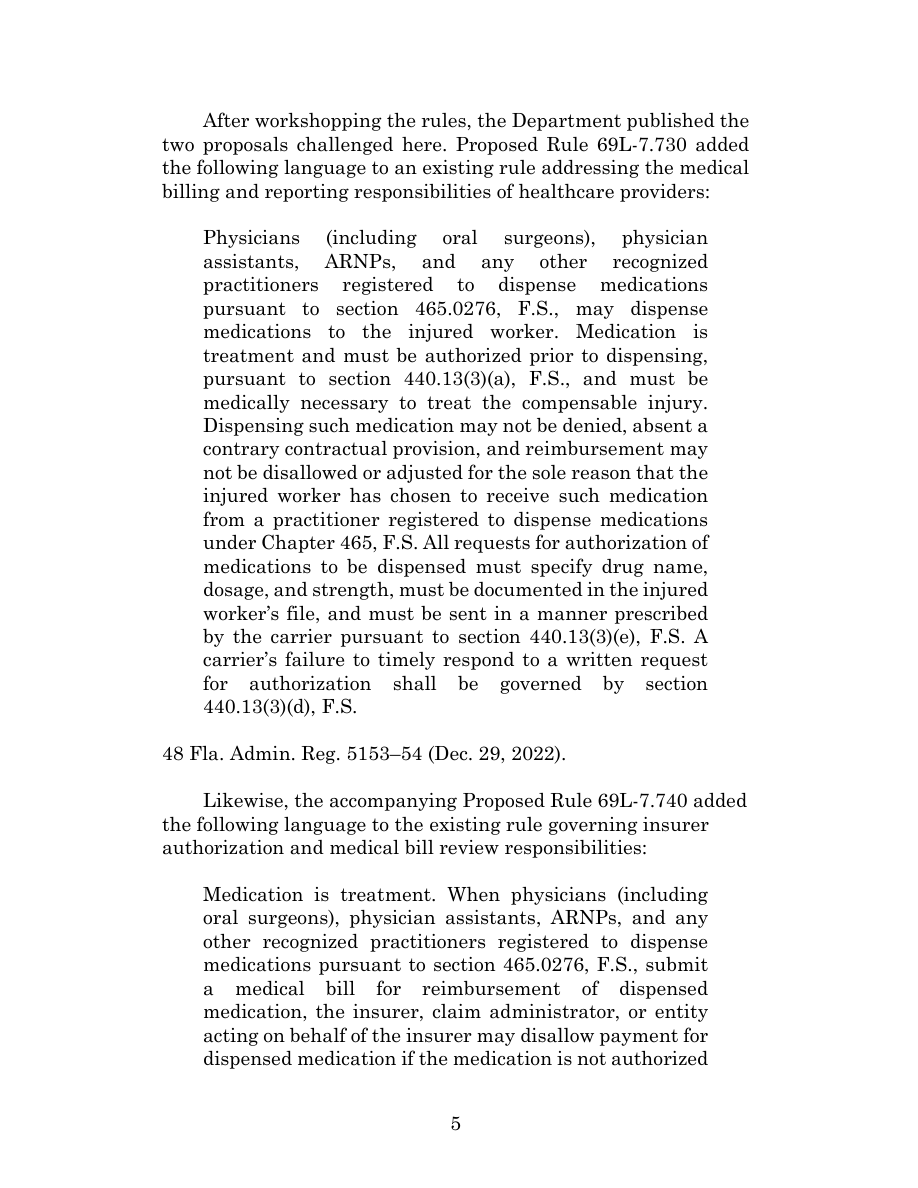
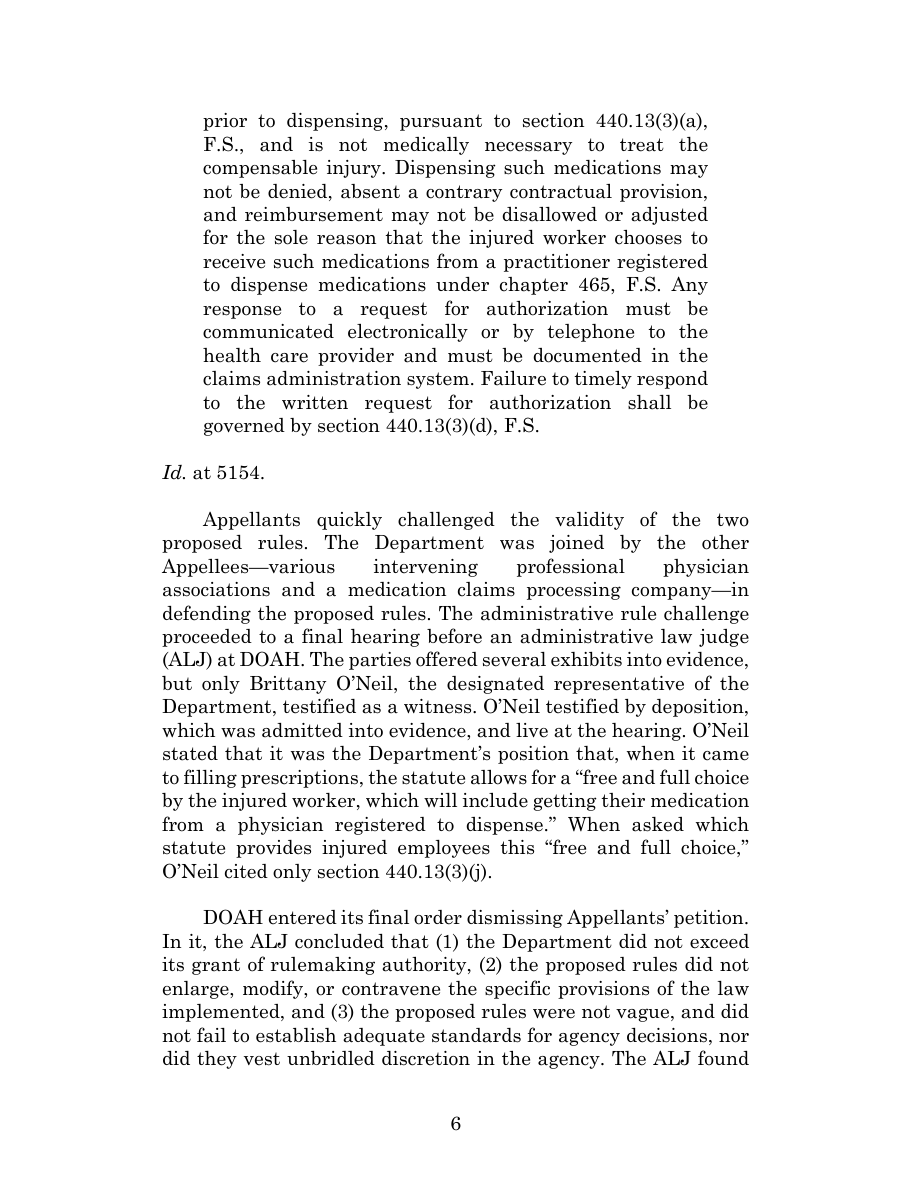
that dispensing practitioners are engaged in the practice of pharmacy, because like pharmacists, dispensing practitioners are permitted to “dispense” medicinal drugs. The ALJ concluded that “[r]egistration of a dispensing practitioner under the Pharmacy Act enables the practitioner to engage in the practice of pharmacy and requires them to ‘comply with and be subject to all laws and rules applicable to pharmacists and pharmacies, including, but not limited to, [Chapter 465].’” We now review that order.
II.
We review an ALJ’s factual findings for competent, substantial evidence. MB Doral, LLC v. Dep’t of Bus. & Pro. Regul., Div. of Alcoholic Beverages & Tobacco, 295 So. 3d 850, 853 (Fla. 1st DCA 2020). Whether an agency has exceeded its rulemaking authority or enlarged the specific provisions of the law purportedly implemented are issues of law that we review de novo. S. Baptist Hosp. of Fla. v. Ag. for Health Care Admin., 270 So. 3d 488, 500 (Fla. 1st DCA 2019). We afford no deference to the agency’s interpretation of statutes. Art. V, § 21, Fla. Const.
In the administrative arena, the agency bears the burden to prove by a preponderance of the evidence that the proposed rule is not an invalid exercise of delegated legislative authority. § 120.56(2)(a), Fla. Stat.; S. Baptist Hosp. of Fla., 270 So. 3d at 500. And proposed rules are afforded no presumption of validity or invalidity. § 120.56(2)(c), Fla. Stat.
A.
Appellants argue that each of the proposed rules is an invalid exercise of delegated legislative authority under section 120.52(8)(c) because it “enlarges, modifies, or contravenes the specific provisions of law implemented.”* We agree that both rules
* We note that Appellants also argue in their initial brief that the proposed rules are invalid under section 120.58(e) because they are arbitrary and capricious. But under the parties’ earlier stipulation, Appellants had agreed not to challenge the rules on this basis at DOAH, so it was never raised or presented to the are invalid, as neither can be squared with the plain language of the “absolute choice” provision in section 440.13(3)(j).
We start in Florida’s Administrative Procedure Act. Agency rulemaking begins with two key ingredients: (1) rulemaking authority, and (2) a specific law to be implemented. § 120.536(1), Fla. Stat. “Rulemaking authority” is statutory language that explicitly authorizes or requires an agency to adopt rules. § 120.52(17), Fla. Stat. While the “law implemented” is the “language of the enabling statute being carried out or interpreted by an agency through rulemaking,” § 120.52(9), Fla. Stat., both components work together to ground the rulemaking process in clear authority with a specific scope. See § 120.52(8), Fla. Stat. (“An agency may adopt only rules that implement or interpret the specific powers and duties granted by the enabling statute. . . . Statutory language granting rulemaking authority or generally describing the powers and functions of an agency shall be construed to extend no further than implementing or interpreting the specific powers and duties conferred by the enabling statute.”).
Given this, a rule may be challenged as an invalid exercise of delegated legislative authority where it “goes beyond the powers, functions, and duties delegated by the Legislature.” § 120.52(8), Fla. Stat. One way an agency can violate this is by putting forth a rule that “enlarges, modifies, or contravenes the specific provisions of law implemented.” § 120.52(8)(c), Fla. Stat. In assessing whether a rule exceeds the boundaries of its implementing statute, “[i]t is not enough that the . . . rule is ‘reasonably related’ to the Legislature’s purpose or statutory provisions.” G.B. v. Ag. for Pers. with Disab., 143 So. 3d 454, 457 (Fla. 1st DCA 2014) (quoting § 120.536(1), Fla. Stat.). Rather, the
ALJ. We will not consider this newly raised and unpreserved argument for the first time on appeal. Dep’t of Bus. & Pro. Regul., Const. Indus. Lic. Bd. v. Harden, 10 So. 3d 647, 649 (Fla. 1st DCA 2009) (“It is well-established that for an issue to be preserved for appeal, it must be raised in the administrative proceeding of the alleged error.”).
rule and interpretation advanced by the agency must fully comport with the specific statute being implemented. Id.
In defending the proposed rules, the Department identified a host of statutory provisions as authority for its actions. For example, the Department’s rulemaking authority to adopt rules to implement the provisions of Chapter 440 comes from section 440.591, Florida Statutes. The Department also cited sections 440.09, 440.13(2)(a), (3), (4), (6), (11), (12), (14), (16), 440.15(3)(b), (d), (5), 440.185(5), (9), 440.20(6), 440.525(2), and 440.593, Florida Statutes, as the enabling statutes for its proposed rules. A review of these provisions, though, reveals that only section 440.13(3)(j) speaks to the Department’s ability to regulate on where an injured employee’s medication can be dispensed. The remaining statutes cited are mostly unrelated substantive workers’ compensation provisions. Some touch upon the Department’s rulemaking authority in other contexts, and one governs carriers’ pre-treatment authorization control and reimbursement rates. They in no way address where medication can be dispensed.
We also note that the Department’s representative, Brittany O’Neil, stated that the Department’s rule was based on its interpretation of section 440.13(3)(j). And in briefing and at oral argument, Appellees failed to direct this Court to any other statute that speaks to the Department’s power to promulgate regulations on where medication for injured employees can be dispensed. Given all this, we look to section 440.13(3)(j) as the specific implementing law for the Department’s proposed rules.
B.
Having identified section 440.13(3)(j) as the specific implementing law at issue, we now turn to whether the Department’s proposed rules fall within the sweep of that enabling statute’s language. “Either the enabling statute authorizes the rule[s] at issue or it does not.” Sw. Fla. Water Mgmt. Dist. v. Save the Manatee Club, Inc., 773 So. 2d 594, 599 (Fla. 1st DCA. 2000). As detailed below, the language of section 440.13(3)(j) fails to authorize either of the proposed rules.
To recap, section 440.13(3)(j) entitles an injured employee “to free, full, and absolute choice in the selection of the pharmacy or pharmacist dispensing and filling prescriptions for medicines required under this chapter.” § 440.13(3)(j), Fla. Stat. It also expressly forbids any interference by the Department, employer, or insurance carrier in the “selection by the sick or injured employee of a pharmacy or pharmacist.” Id. So the heart of our inquiry is whether the phrase “pharmacy or pharmacist” in section 440.13(3)(j) can be read to encompass a dispensing practitioner.
Because Chapter 440 fails to expressly define the terms pharmacy or pharmacist, we consider “all the textual and structural clues” that may shed light on their specific meaning within the “absolute choice” provision. Conage v. United States, 346 So. 3d 594, 598 (Fla. 2022) (quoting Alachua Cnty. v. Watson, 333 So. 3d 162, 169 (Fla. 2022)). This includes the plain and ordinary meaning of these common words within the statute’s context. See Ripple v. CBS Corp., 385 So. 3d 1021, 1027 (Fla. 2024) (citing Barnett v. Dep’t of Fin. Servs., 303 So. 3d 508, 513 (Fla. 2020) (“Because the Act does not define the term ‘surviving spouse,’ we accord the phrase its ordinary meaning while giving regard to the context in which the phrase is used.”)).
Typically, the word pharmacist refers to someone licensed and trained in the practice of pharmacy. See Pharmacist, Webster’s Third New International Dictionary 1694 (1986) (defining “pharmacist,” in part, as “one engaged in the practice of pharmacy.”); Pharmacist, The American Heritage Dictionary (3d ed. 1994) (defining “pharmacist” as “one trained in pharmacy.”); Pharmacist, Dorland’s Illustrated Medical Dictionary (27th ed. 1988) (defining “pharmacist” as “one who is licensed to prepare and sell or dispense drugs and compounds, and make up prescriptions.”).
Beyond Florida’s Workers’ Compensation Law, Chapter 465 of the Florida Statutes governs and regulates pharmacists. In section 465.003, the Legislature defines “pharmacist” as “any person licensed pursuant to this chapter to practice the profession of pharmacy.” § 465.003(19), Fla. Stat. And section 465.003 outlines the “[p]ractice of the profession of pharmacy” to “include compounding, dispensing, and consulting concerning contents, therapeutic values, and uses of any medicinal drug” § 465.003(22), Fla. Stat. Meanwhile, section 465.0276, the “dispensing practitioner”
statute, expressly differentiates between a pharmacist and a dispensing practitioner:
A person may not dispense medicinal drugs unless licensed as a pharmacist or otherwise authorized under this chapter to do so, except that a practitioner authorized by law to prescribe drugs may dispense such drugs to her or his patients in the regular course of her or his practice in compliance with this section.
§ 465.0276(1)(a), Fla. Stat. (emphasis added). The statute’s use of “except” provides an exception to the general prohibition that only licensed pharmacists are allowed to dispense medication. The statute’s clear language establishes that dispensing practitioners are the only non-pharmacists permitted to distribute medication, thus making them distinct from licensed pharmacists.
With all of this in mind, we do not find the term “pharmacist” in section 440.13(3)(j) to include a dispensing practitioner. A “pharmacist” is someone licensed to practice pharmacy under Chapter 465. The Department contends that by registering to be a dispensing practitioner, healthcare providers obtain a “limited license” to practice pharmacy. Not so. Chapter 465 makes clear that a “license” to practice pharmacy is obtained in only two ways: (1) through examination or (2) endorsement. § 465.007, Fla. Stat.; § 465.0075, Fla. Stat. Both forms of licensing require that the candidate (1) obtain a degree from a pharmacy college or school, (2) complete a board-certified internship program, and (3) pass the Florida pharmacy exam or a comparable exam. § 465.007, Fla. Stat.; § 465.0075, Fla. Stat. Meanwhile, dispensing practitioners are not subject to the same rigorous licensing requirements. To become a dispensing practitioner, a practitioner only needs to register with their professional licensing board, pay a fee of less than $100, and follow the rules as dictated in the statute. At most, practitioners who register as dispensing practitioners have a “dispensing practitioner license” but do not possess the license, training, or credentials to be considered a licensed pharmacist.
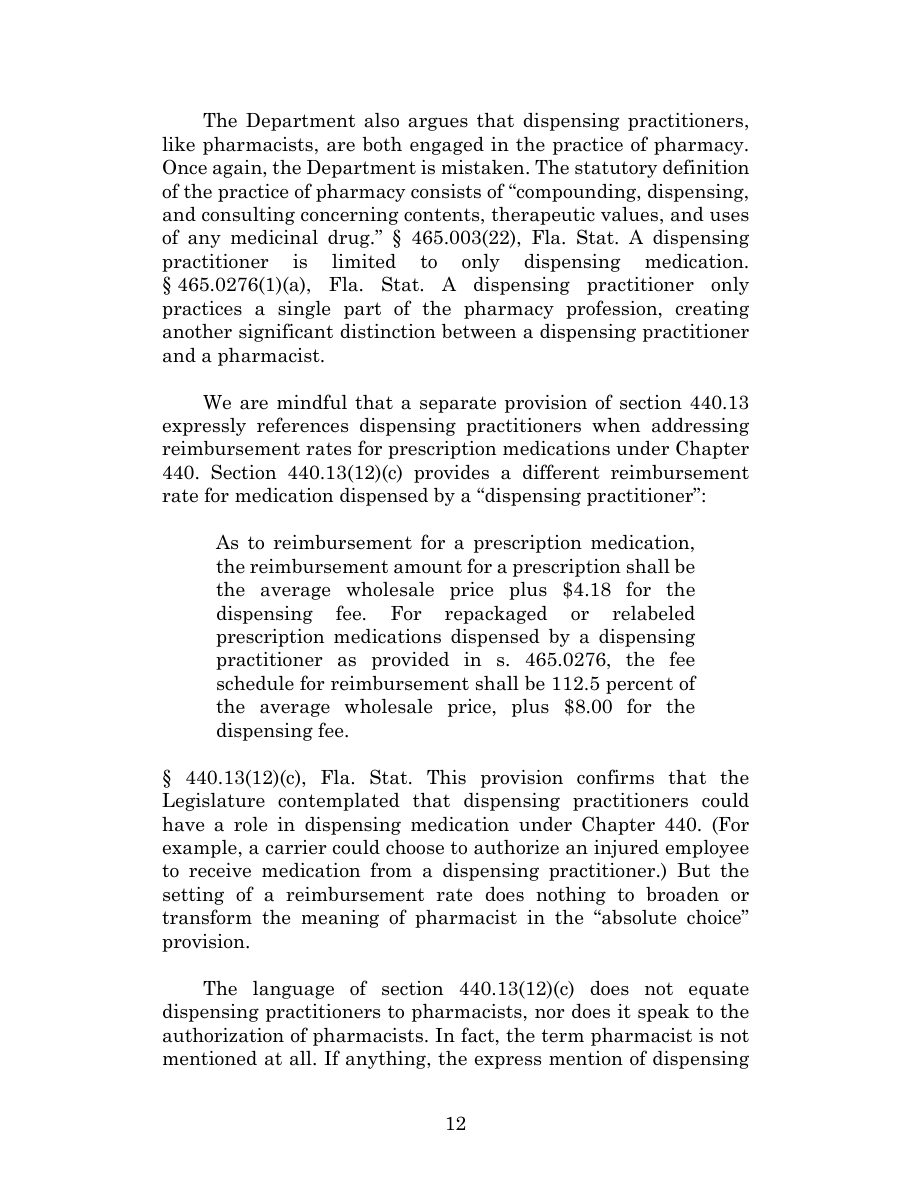
practitioners in section 440.13(12)(c) is further evidence that the Legislature intended to omit dispensing practitioners from the absolute choice provision. See L.K. v. Dep’t of Juv. Just., 917 So. 2d 919, 921 (Fla. 1st DCA 2005) (“It is a general canon of statutory construction that, when the legislature includes particular language in one section of a statute but not in another section of the same statute, the omitted language is presumed to have been excluded intentionally.”).
Had the Legislature wanted dispensing practitioners to be included in the “absolute choice” provision, it could have expressly included them in section 440.13(3)(j) or used a broader term like “health care provider,” which would have covered physicians and pharmacists and is used in other parts of section 440.13. We decline to read so broadly language that the Legislature has written narrowly. See Hayes v. State, 750 So. 2d 1, 4 (Fla. 1999) (“We are not at liberty to add words to statutes that were not placed there by the Legislature.”); Fla. Dep’t of Revenue v. Fla. Mun. Power Ag., 789 So. 2d 320, 324 (Fla. 2001) (“A court’s function is to interpret statutes as they are written and give effect to each word in the statute.”).
We conclude that the “absolute choice” provision in section 440.13 fails to include dispensing practitioners. Section 440.13(3)(j) provides that injured employees are entitled to choose their own pharmacy or pharmacist. Dispensing practitioners do not fit within the plain meaning of “pharmacist” nor do they engage in the “practice of the profession of pharmacy.” Thus, Rules 69L-7.730(2)(1)1.b and 69L-7.740(2)(c) improperly enlarge, modify, or contravene section 440.13(3)(j) and are an invalid exercise of delegated legislative authority under section 120.52(8)(c). See MB Doral, LLC v. Dep’t of Bus. & Pro. Regul., Div. of Alcoholic Beverages & Tobacco, 295 So. 3d 850, 855 (Fla. 1st DCA 2020) (reversing an ALJ order after finding that Agency’s rule improperly enlarges, modifies, or contravenes Florida Law); G.B., 143 So. 3d at 457 (reversing an ALJ order finding a rule valid where the rule expanded and contravened the law implemented).
We SET ASIDE the final order.
ROWE and LONG, JJ., concur.
Not final until disposition of any timely and authorized motion under Fla. R. App. P. 9.330 or 9.331.
William H. Rogner of HR Law, Orlando, for Appellants.
Cassidy Perdue, Katie Privett, and Douglas Ware, Department of Financial Services, Tallahassee, for Appellee Department of Financial Services.
Jeffery M. Scott, Florida Medical Association, Tallahassee; Jason D. Winn, Winn Law, Tallahassee; Virginia C. Dailey, Louise Wilhite-St. Laurent, and Lindsay K. Ervin, Panza, Maurer & Maynard, P.A., Tallahassee; for Appellees Prescription Partners, LLC, Florida Medical Association, Inc., Florida Osteopathic Medical Association, and Florida Orthopaedic Society.
Maria Elena Abate and L. Michael Billmeier, Jr., Colodny Fass, Tallahassee, for Amici Curiae American Property and Casualty Insurance Association and Florida Insurance Council.