
DISTRICT COURT OF APPEAL OF FLORIDA SECOND DISTRICT
ANDREA DAVIDSON,
Appellant,
v.
SHANA DEES, HARISH CHARMARTHY, and KAHLER MacPHAIL,
Appellees.
No. 2D2023-1034
December 27, 2024
Appeal pursuant to Fla. R. App. P. 9.130 from the Circuit Court for Hillsborough County; Rex Martin Barbas, Judge.
Samuel J. Salario, Jr., and Caroline M. Poor of Lawson Huck Gonzalez, PLLC, Tampa; and Kevin C. Ambler of Ambler Law Group, Tampa, for Appellant.
Richard A. Harrison of Richard A. Harrison, P.A., Tampa, for Appellee Shana Dees.
No appearance for Appellees Harish Charmarthy and Kahler MacPhail.
NORTHCUTT, Judge.
This is an appeal from an order denying a motion for relief from the second amended final judgment in a foreclosure case and an order on a motion for rehearing of that order. Procedural irregularities have plagued this case in the circuit court and rendered this appeal anything but simple. We have sorted it nevertheless, and we reverse.
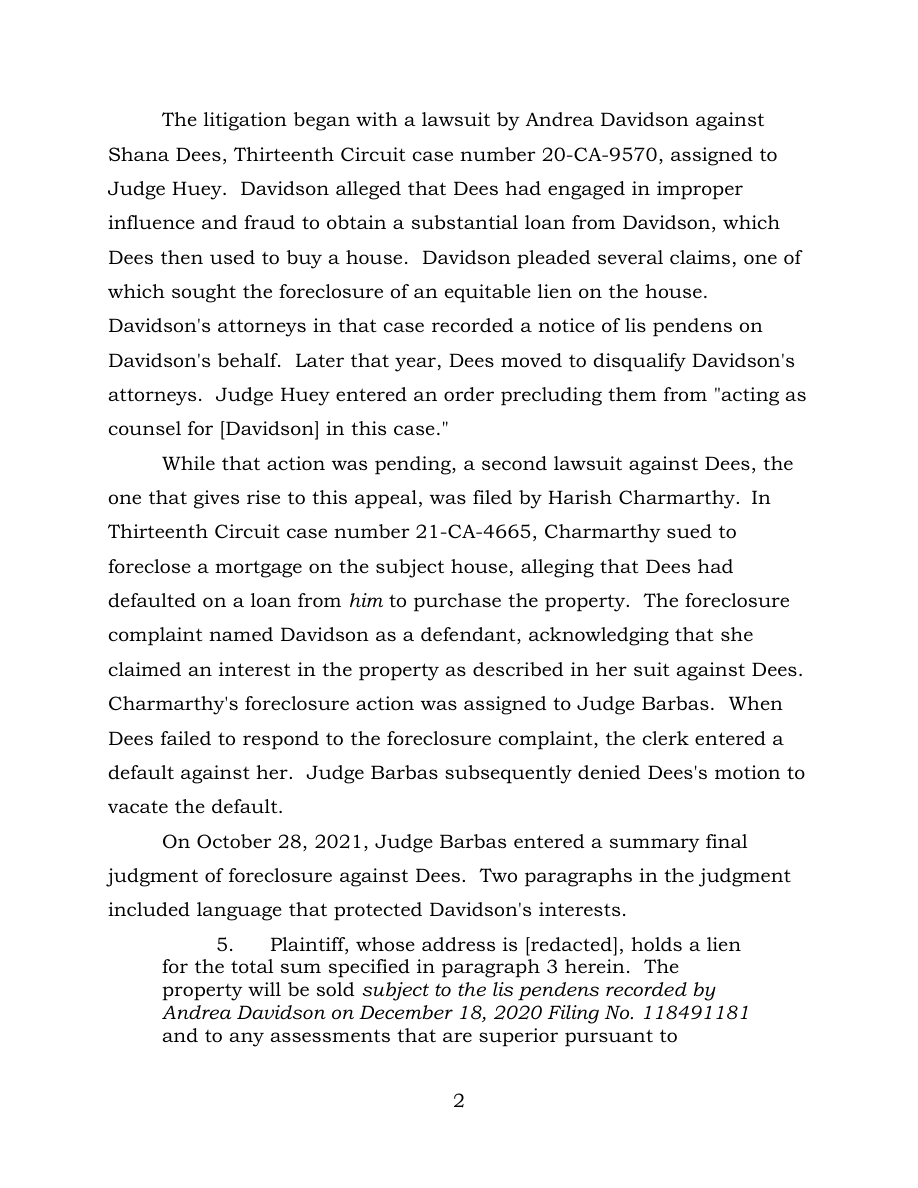
sections 718.116 and 720.3085, Florida Statutes, and same is described as follows: [legal description omitted] . . . .
11.
On filing of the Certificate of Sale, defendant(s) and all persons claiming under or against defendant(s) since the filing of the Notice of Lis Pendens shall be foreclosed of all estate or claim in the property except as to claims or rights of Andrea Davidson pursuant to the Lis Pendens recorded on December 18, 2020 Filing No. 118491181 or claims under chapter 718 or 720 Florida Statutes, if any. On filing of the Certificate of Sale, defendant's right of redemption as provided by section 45.0315, Florida Statutes shall be terminated. At this point, the two proceedings began to converge. In the fraud case, Davidson's previously disqualified attorneys recorded an amended notice of lis pendens. Dees filed an emergency motion to strike it late in the afternoon of January 26, 2022, serving the emergency motion on "all counsel of record." Judge Huey granted that motion and struck the amended notice of lis pendens by order filed the following evening. The order stated that Judge Huey had considered and ruled on the motion ex parte. It indicated that copies were furnished to Davidson's former counsel, but it did not reflect that it was sent to Davidson, who was unrepresented owing to Judge Huey's order disqualifying her attorneys.
Although Dees had been defaulted out of Judge Barbas's foreclosure case, she reinserted herself into that case by filing a "notice of filing" of Judge Huey's order striking Davidson′s amended notice of lis pendens. She filed the notice half an hour after the order's entry, apparently to notify Judge Barbas of it.
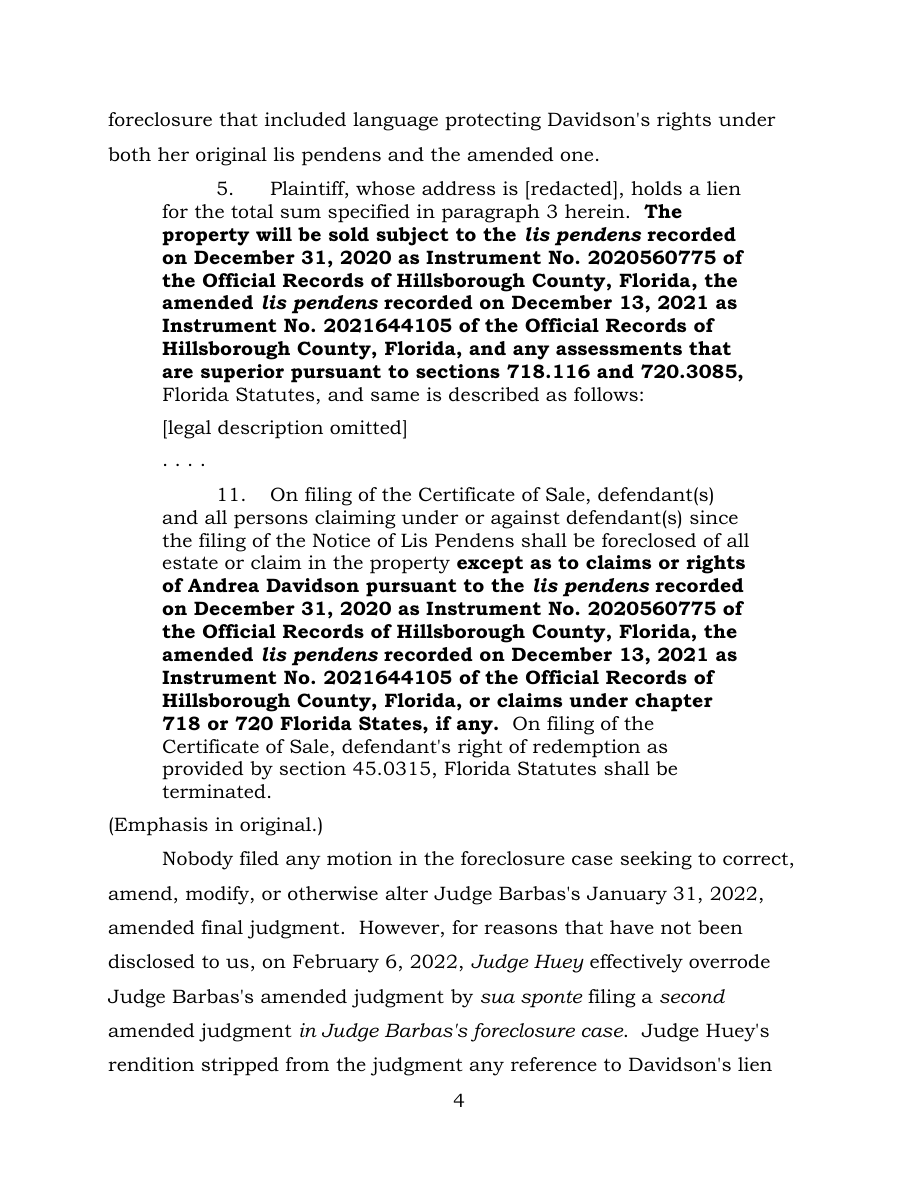
It is unclear whether Judge Barbas was aware of that filing when, on January 31, 2022, he entered an amended final judgment of
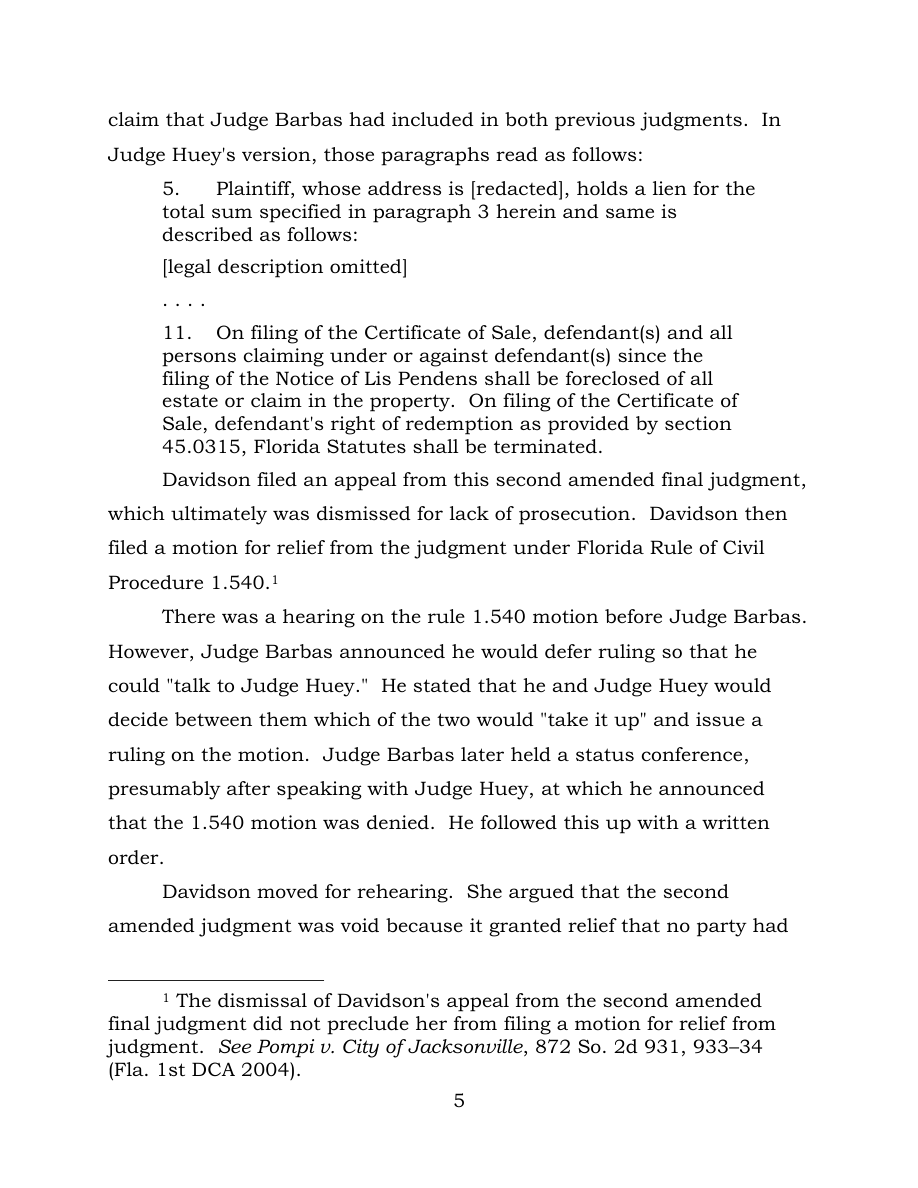
requested and it was entered without Davidson having received due process. Davidson also complained that the second amended final judgment granted relief in favor of Dees, who was entitled to no relief because she had been defaulted.
Judge Barbas granted the motion for rehearing, but in the same order he denied the requested relief. The order stated that: Ms. Davidson received due process in connection with Ms. Dee's [sic] Emergency Motion to Strike Unauthorized 'Amended Notice of Lis Pendens,' For Contempt and For Sanctions filed on January 26, 2022 in the 2020 Case [the fraud case], such that the [second amended final judgment] entered in this case on February 6, 2022 is not void. (Emphasis added.)
We disagree. The second amended judgment was void because it eliminated Davidson's rights without due process of law. As the appellee's counsel appropriately conceded at oral argument in this case, no party requested that either of these judges modify the amended final judgment to remove the language protecting Davidson's lien rights. There was no motion under rule 1.540 seeking relief from the judgment, there was no notice that a judge overseeing another case was going to grant that relief, and there was no hearing at which the possibility of that relief being granted was discussed.
Judge Barbas's finding that Davidson received due process by virtue of Judge Huey's order on Dees's motion to strike the amended lis pendens in the fraud case is contradicted by the record. Dees's motion stated that it was served on "counsel of record," but Davidson was unrepresented. Consequently, there is no record of any service or notice to Davidson. See Fla. R. Gen. Prac. & Jud. Admin. 2.516(h)(1)(C)–(D) (requiring service on a party not represented by an attorney to be sent to that party's e-mail address(es) or, with some exceptions, to the party via mail). Judge Huey's order stated that he considered Dees's motion ex parte; thus, Davidson was given no opportunity to be heard on the matter. Judge Huey sent copies of the order to Davidson's previously disqualified counsel, but not to Davidson; thus, the record does not even reflect proper service, or any notice, to Davidson even after the fact. See rule 2.516(h)(1) ("A copy of all orders or judgments must be transmitted by the court or under its direction to all parties at the time of entry of the order or judgment.") (Emphasis added). Judge Barbas's belief notwithstanding, Davidson received no due process in connection with Dees's motion to strike the amended lis pendens.
Even if Davidson had been afforded due process in the fraud case, it would not have sufficed to provide due process in this case. In the fraud case, Judge Huey struck only the amended notice of lis pendens, leaving the original notice of lis pendens intact. But when he sua sponte entered the second amended foreclosure judgment, he eliminated the judgment's references to both the original and the amended lis pendens. This modification to the foreclosure judgment exceeded even what Dees had requested and Judge Huey had granted in the fraud case. In short, the record does not support Judge Barbas's view that proceedings in the fraud case were an adequate substitute for the due process to which Davidson was entitled in the foreclosure case.
Judge Huey's second amended final judgment in the foreclosure case, making a substantive amendment without giving Davidson notice or an opportunity to be heard, violated due process and was therefore void. See Fantauzzi v. Fleck, 385 So. 3d 1098, 1102 (Fla. 2d DCA 2024) (quoting Viets v. Am. Recruiters Enters., 922 So. 2d 1090, 1095 (Fla. 4th DCA 2006)). Moreover, "[g]ranting unrequested relief absent proper notice is a violation of due process." Stover v. Stover, 287 So. 3d 1277, 1279 (Fla. 2d DCA 2020). Consequently, the circuit court should have granted Davidson's rule 1.540 motion for relief from the second amended final judgment.
The error was compounded by the fact that the relief granted by Judge Huey's second amended final judgment was in favor of Dees, who was not an active party in the foreclosure case because she had long previously been defaulted. Judge Barbas had denied her motion to vacate the default and then entered judgment in favor of the plaintiff. With that judgment in place and the amount of damages settled, Dees had no rights remaining in the foreclosure case. See Fla. Bar v. Porter, 684 So. 2d 810, 813 n.4 (Fla. 1966) (holding that a defaulted party "has the right to contest damages caused by the party's wrong but no other issue"); see also Donohoe v. Brightman, 939 So. 2d 1162, 1165 (Fla. 4th DCA 2006) (holding that entry of default "cut off [the defendant's] right to defend the allegations and claims for relief"). Dees had no right to seek or obtain a judgment more favorable to her interests.
For the reasons stated, we reverse the orders under review. On remand, the circuit court shall grant Davidson's 1.540 motion and vacate the second amended final judgment.
Reversed and remanded.
SILBERMAN and MORRIS, JJ., Concur.
Opinion subject to revision prior publication.