
SIXTH DISTRICT COURT OF APPEAL
STATE OF FLORIDA
Case No. 6D2023-0825 Lower Tribunal No. CF19-007074-XX
KYLE KENNETH KLICK,
Appellant, v.
STATE OF FLORIDA,
Appellee.
Appeal from the Circuit Court for Polk County.
Sharon M. Franklin, Judge.
August 30, 2024
PER CURIAM.
This criminal appeal presents the question of whether the Florida Supreme Court’s holding in Brown v. State, 260 So. 3d 147 (Fla. 2018), applies to a defendant’s resentencing that occurs upon the revocation of the defendant’s original probationary sentence.1 Adopting the Second District’s reasoning in Shields v. State, 296 So. 3d 967 (Fla. 2d DCA 2020), we hold that Brown does apply to a resentencing that occurs after the revocation of a defendant’s original probationary sentence.
Background and Procedural History
Appellant Kyle Klick (“Defendant”) pled nolo contendere to a charge of felony petit theft, a third-degree felony, under section 812.014(3)(c), Florida Statutes (2019). He scored 12.2 points on his Criminal Punishment Scoresheet which required that he be sentenced to a nonstate prison sanction. See § 775.082(10), Fla. Stat. (2019). The trial court adjudicated him guilty and sentenced him to sixty days in the county jail followed by thirty-six months’ probation.
After Defendant served his jail sentence and during his period of probation, his probation officer filed an affidavit of violation of probation alleging that Defendant committed a petit theft, which constituted a violation of one of the conditions of his probation. Subsequently, the violation of probation affidavit was amended to add three additional allegations of violations of his probation, including failing to report to his probation officer and committing the new offense of driving with a suspended or revoked driver’s license.
Defendant admitted to all of the allegations in the amended affidavit of violation of probation. The trial court revoked Defendant’s probation and conducted a resentencing. At the resentencing, Defendant’s counsel argued that because Defendant scored only 12.2 points, he could not be sentenced to prison. Defendant’s counsel argued that a county jail sentence between time served and 364 days was appropriate. The State recited Defendant’s criminal history of theft and requested that the trial court impose a sentence of four years in state prison. The State noted that the trial court would have to make written findings in order to justify the prison sentence.
The trial court agreed with the State’s argument and sentenced Defendant to four years in state prison. In its oral ruling, the trial court found that Defendant was a danger to the community based on Defendant’s prior history of recidivism. The trial court then issued its “Written Findings Pursuant to Section 775.082(10), Fla. Statutes” (“Written Findings”) in which it justified the “upward departure” of Defendant’s sentence. In its Written Findings, the trial court found, among other things, that: The offender’s blatant conduct with regards to the new theft charge in Orange County while on probation and the numerous criminal convictions for Petit Theft indicate that the offender poses a danger and a threat to the community and a threat to property in the State of Florida and an upward departure was necessary to protect the public from the defendant’s behavior. Defendant filed a timely notice of appeal of the trial court’s sentence and subsequently, a motion to correct sentencing error, which was deemed denied under Florida Rule of Criminal Procedure 3.800(b)(2)(B) when the trial court failed to rule on the motion within sixty days.
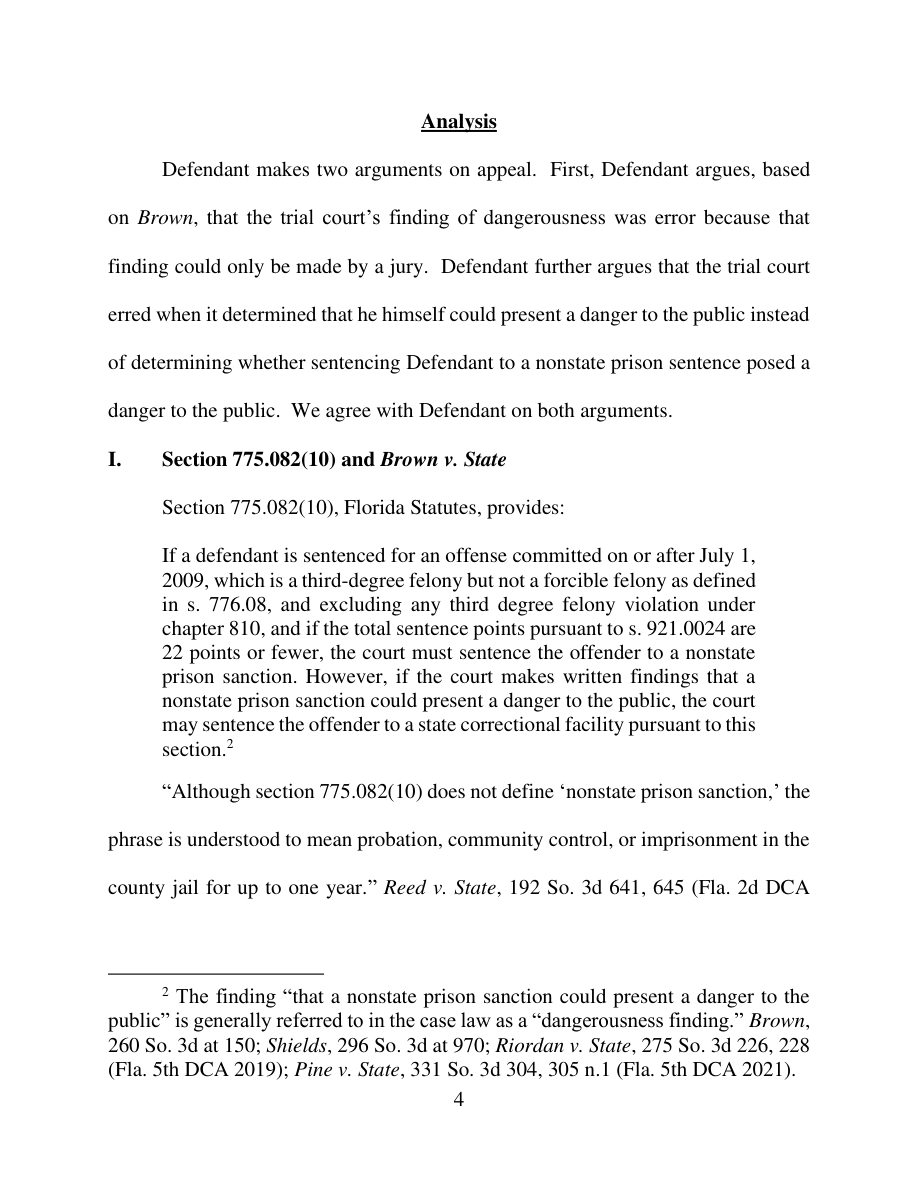
2016) (quoting Jones v. State, 71 So. 3d 173, 175 (Fla. 1st DCA 2011) (internal
quotations omitted)).
In Brown, applying Apprendi3 and Blakely4, the Florida Supreme Court held
that a jury must make the required finding of dangerousness (or the defendant must
admit to it) before a state prison sentence can be imposed under Section 775.082(10).
260 So. 3d at 150-51.
The [Florida Supreme Court] explained that the statutory maximum sentence for a defendant with fewer than twenty-two sentencing points is “a nonstate prison sanction,” since that is the maximum sentence that a judge could impose solely on the basis of the facts reflected by a jury verdict. [Brown, 260 So. 3d at 150] (citing Blakely, 542 U.S. at 303, 124 S.Ct. 2531). It therefore held that “subsection (10) violates the Sixth Amendment in light of Apprendi and Blakely based on its plain language requiring the court, not the jury, to find the fact of dangerousness to the public necessary to increase the statutory maximum nonstate prison sanction.” Id. “In order for a court to impose any sentence above a nonstate prison sanction when section 775.082(10) applies, a jury must make the dangerousness finding.” Id. at 151.
Shields, 296 So. 3d at 970. Thus, at Defendant’s original sentencing upon his plea
of nolo contendere, the trial court could not have sentenced Defendant to state prison
without a jury finding of dangerousness under Section 775.082(10).
The question presented in this case is whether the judge was permitted to make
the finding of dangerousness at Defendant’s resentencing upon revocation of his
3 Apprendi v. New Jersey, 530 U.S. 466 (2000). 4 Blakely v. Washington, 542 U.S. 296 (2004).
probation or, pursuant to Brown, was a jury required to make the finding of dangerousness. In other words, does the holding of Brown apply to a resentencing that occurs after the revocation of a defendant’s original probationary sentence? Writing for the Second District, former Judge Salario addressed this question directly and, we believe, correctly in Shields. Having reviewed Judge Salario’s reasoning in Shields, we cannot improve upon it. For this reason, we adopt the reasoning of Shields and hold that Brown applies to a resentencing that occurs after the revocation of a defendant’s original probationary sentence. Thus, when a defendant that was sentenced to a nonstate prison sanction under Section 775.082(10) is subsequently resentenced for the defendant’s original offense upon a revocation of the defendant’s original probationary sentence, the trial court cannot sentence the defendant to state prison unless a jury makes the dangerousness finding required by Section 775.082(10).
The Florida Supreme Court has held that the remedy for a court, instead of a jury, making the finding of dangerousness under Section 775.082(10) is to remand with instructions to either impose a nonstate prison sanction or to empanel a jury to make the required dangerousness finding, if the State seeks that finding at the resentencing. Gaymon v. State, 288 So. 3d 1087, 1093 (Fla. 2020). Therefore, we reverse Defendant’s sentence and remand with that instruction.
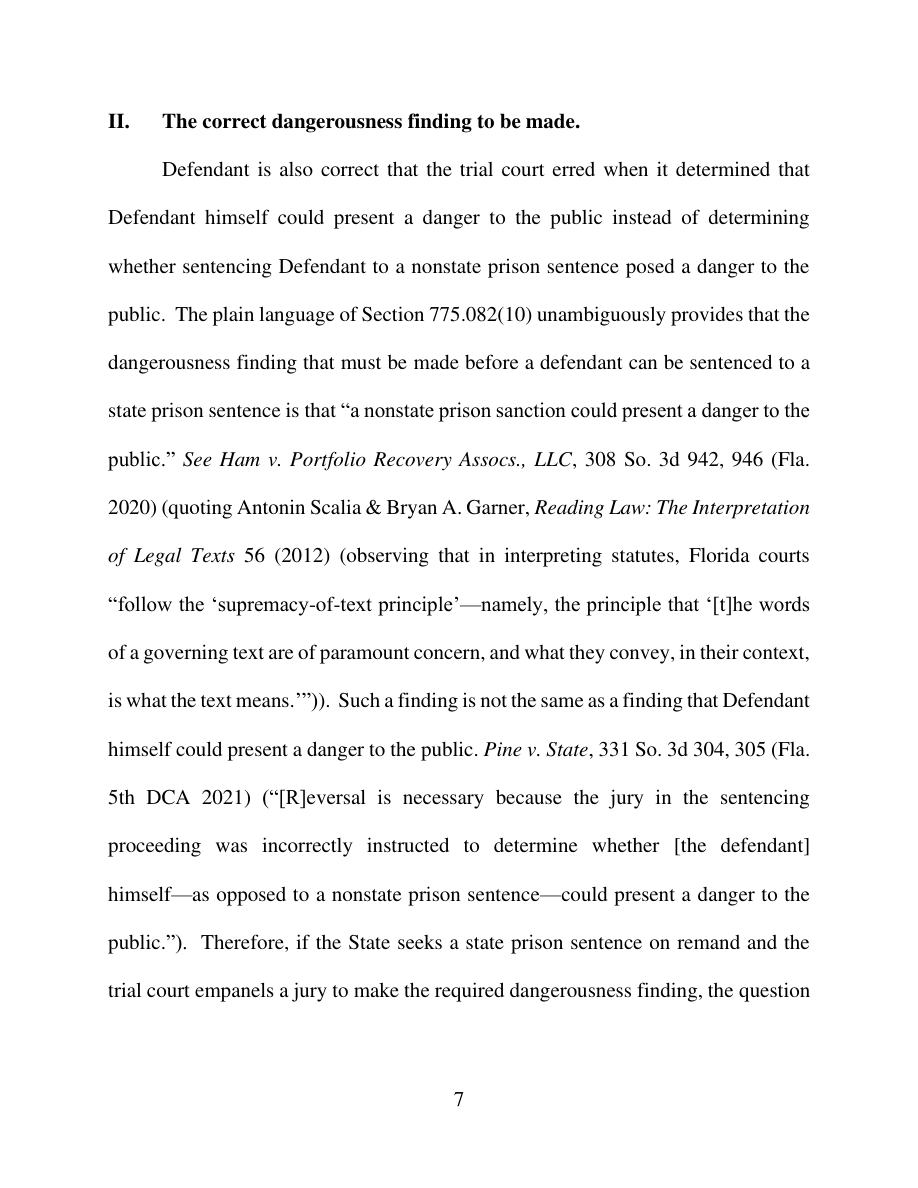
the jury must be instructed to decide is whether sentencing Defendant to a nonstate
prison sentence could present a danger to the public.5
Conclusion
Defendant’s sentence is reversed, and this case is remanded to the trial court
for further proceedings consistent with this opinion.
REVERSED and REMANDED with instructions.
NARDELLA and MIZE, JJ., and LAMBERT, B.D., Associate Judge, concur.
Howard L. “Rex” Dimmig, II, Public Defender, and Maureen E. Surber, Assistant Public Defender, Bartow, for Appellant.
Ashley Moody, Attorney General, Tallahassee, and Sonia C. Lawson, Assistant Attorney General, Tampa, for Appellee.
NOT FINAL UNTIL TIME EXPIRES TO FILE MOTION FOR REHEARING AND DISPOSITION THEREOF IF TIMELY FILED
Footnotes
1 This case was transferred from the Second District Court of Appeal to this Court on January 1, 2023.Back to text
5 While the appropriate language for such a jury instruction is not an issue before us in this appeal, we can foresee the complexities involved in drafting a jury instruction that properly instructs a jury to decide whether sentencing a defendant to a nonstate prison sentence could present a danger to the public. For this reason, we hereby make a referral to the Committee on Standard Jury Instructions in Criminal Cases to consider recommending a standard jury instruction concerning the application of Section 775.082(10). The Clerk of Court will forward a copy of this opinion to the Committee.Back to text